Theoretical condensed matter · DTU Physics

Engineering quantum materials with light

We develop first-principles theory to understand and control materials through strong light–matter interaction, from optical cavities to ultrafast laser pulses.

Illustration of a crystal lattice interacting with light

About the group

Light as a tool to tailor materials

We are a condensed matter physics group specialised in theoretical methods for ab-initio calculations. Based at the Technical University of Denmark and partnered with the Max Planck Institute for the Structure and Dynamics of Matter in Hamburg, we combine quantum electrodynamics, many-body perturbation theory and density functional theory to design materials whose properties can be tailored by light.

  • Cavity materials engineering
  • Strong light–matter interaction
  • Non-equilibrium electron dynamics
  • Optical properties of two-dimensional materials
  • First-principles methods for many-body theory
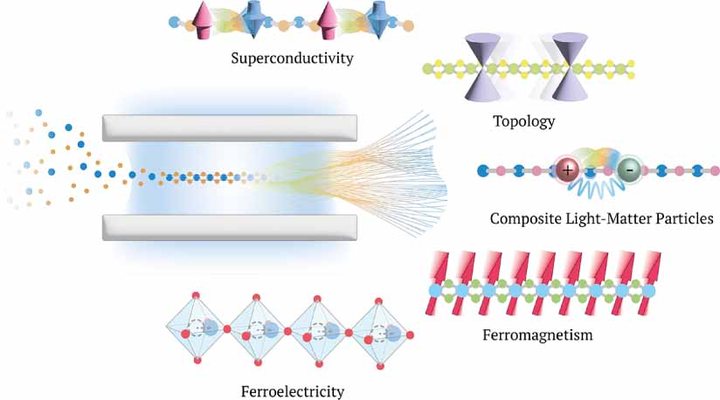
Overview of our research: excitons, two-dimensional materials, materials in optical cavities, and hybrid photon–phonon–exciton states

News

Latest

All news

Villum Young Investigator grant

I am extremely proud to have been awarded a Villum Young Investigator Grant with the goal of designing material functionalities with spatially structured light! Read more about the program here and get in contact for PhD and post-doc positions.
SPARKLE has kicked off

SPARKLE, our Marie Skłodowska-Curie doctoral network, has kicked off! Check out our new website sparkle-dn.eu and join us!

Coordinating the SPARKLE doctoral network

I will be coordinating SPARKLE, a Marie Curie Doctoral Network which will train 14 PhD students across Europe on Polaritonic Materials. Stay tuned for new positions!

Publications

Selected papers

Full list
  1. Mater. Quantum Technol. Quantum materials engineering by structured cavity vacuum fluctuations
    H. Hübener, E. Viñas Boström, M. Claassen, S. Latini, A. Rubio
    Materials for Quantum Technology 4, 023002 (2024)

    A perspective on how structured cavity vacuum fluctuations can switch the ground state of materials. Three theoretical scenarios illustrate quantum phase transitions induced in the dark, without any photons in the cavity.

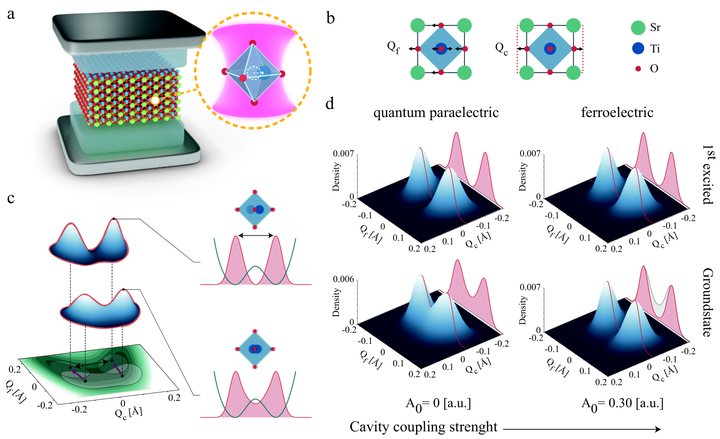
  2. PNAS The ferroelectric photo ground state of SrTiO3: Cavity materials engineering
    S. Latini, D. Shin, S. A. Sato, C. Schäfer, U. De Giovannini, H. Hübener, et al.
    Proceedings of the National Academy of Sciences 118, e2105618118 (2021)

    In the strong light-matter coupling regime, cavity vacuum fluctuations stabilize ferroelectricity as the ground state of SrTiO3. We call this light-matter hybrid ground state a material photo ground state.

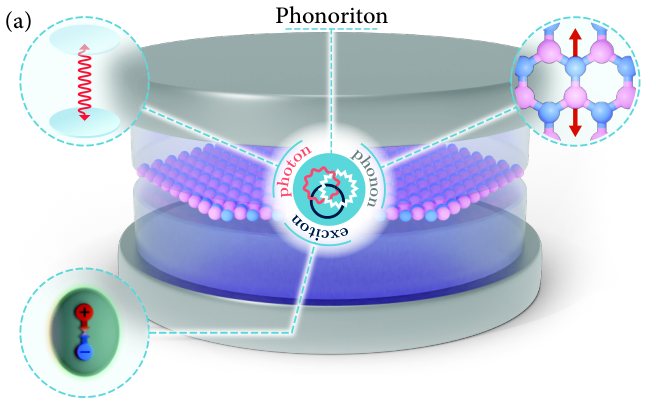
  3. PRL Phonoritons as Hybridized Exciton-Photon-Phonon Excitations in a Monolayer h-BN Optical Cavity
    S. Latini, U. De Giovannini, E. J. Sie, N. Gedik, H. Hübener, A. Rubio
    Physical Review Letters 126, 227401 (2021)

    Monolayer hBN in an optical cavity hosts phonoritons, hybrid excitations of excitons, photons and phonons. We predict clear spectroscopic signatures and propose a realistic route to observe them.

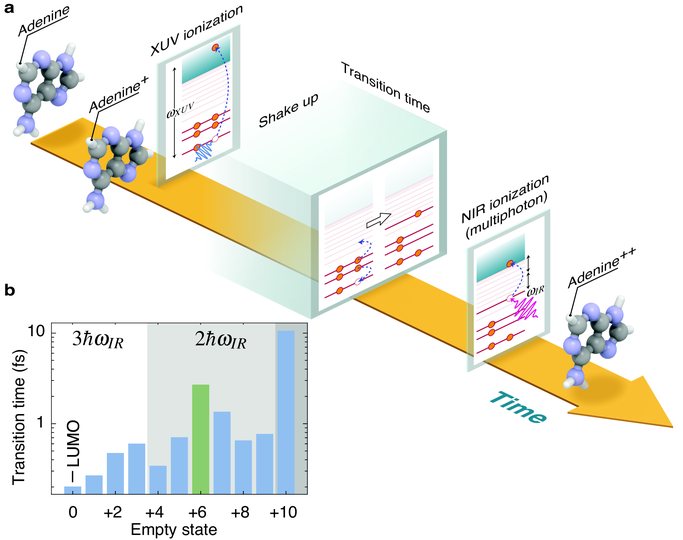
  4. Commun. Chem. Real-time observation of a correlation-driven sub 3 fs charge migration in ionised adenine
    Erik P. Månsson, Simone Latini, Fabio Covito, Vincent Wanie, Mara Galli, Enrico Perfetto, et al.
    Communications Chemistry 4, 73 (2021)

    Attosecond pump-probe spectroscopy captures charge migration in ionized adenine within 3 femtoseconds. Many-body simulations trace this ultrafast motion to electron correlation.

  5. Science Programmable hyperbolic polaritons in van der Waals semiconductors
    A. J. Sternbach, S. H. Chae, S. Latini, A. A. Rikhter, Y. Shao, B. Li, et al.
    Science 371, 617–620 (2021)

    Ultrafast optical pumping turns on hyperbolic dispersion in the van der Waals semiconductor WSe2, creating a transient waveguide for polaritons. This gives an all-optical switch for subwavelength light confinement.

Join us

Open positions

We regularly look for motivated PhD students and postdocs through our Villum Young Investigator project and the SPARKLE Marie Skłodowska-Curie doctoral network.